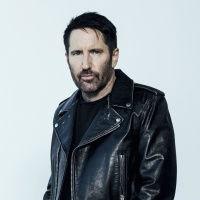
Michael Trent Reznor (born May 17, 1965) is an American singer, songwriter, musician, and composer. He came to prominence as the founder, lead singer, multi-instrumentalist, and primary songwriter of the industrial rock band Nine Inch Nails. The band's line-up has constantly changed, with Reznor being its only official member from its creation in 1988 until 2016, when he added English musician and frequent collaborator Atticus Ross as its second permanent member.
Reznor began his career in 1982 as a member of synth-pop bands such as The Innocent, Slam Bamboo, and Exotic Birds. The first Nine Inch Nails album, Pretty Hate Machine (1989), was a moderate success but largely remained popular with underground audiences; the next two albums, The Downward Spiral (1994) and The Fragile (1999), brought the band widespread critical acclaim. There have since been eight more Nine Inch Nails albums and six EPs. Reznor has also contributed to the work of artists such as rock singer Marilyn Manson, rapper Saul Williams, and pop singer Halsey. Alongside his wife Mariqueen Maandig and long-time collaborators Atticus Ross and Rob Sheridan, he formed the post-industrial group How to Destroy Angels in 2009.
Since 2010, Reznor and Ross have worked on numerous film and television scores, most notably for movies directed by David Fincher and Luca Guadagnino. These include Fincher's The Social Network (2010), The Girl with the Dragon Tattoo (2011), and Gone Girl (2014), as well as Guadagnino's Bones and All (2022), Challengers (2024), and Queer (2024). Reznor and Ross won the Academy Award for Best Original Score for The Social Network and Soul (2020) and the Grammy Award for Best Score Soundtrack for Visual Media for The Girl with the Dragon Tattoo and Soul, sharing both awards for Soul with co-composer Jon Batiste. Reznor and Ross won the Primetime Emmy Award for Outstanding Music Composition for a Limited Series for Watchmen (2019). The pair also scored Ken Burns's 10-part documentary The Vietnam War (2017).
Early life
Michael Trent Reznor was born in New Castle, Pennsylvania, on May 17, 1965, the son of Nancy Lou (née Clark) and Michael Reznor. He is of German and Irish descent, and grew up in Mercer. His great-grandfather, George Reznor, founded the heating and air conditioning manufacturer Reznor Company in 1884. After his parents divorced when he was six years old, Reznor's sister Tera lived with their mother while he went to live with his maternal grandparents. He began playing the piano at the age of 12 and showed an early aptitude for music. His grandfather told People in February 1995, "He was a good kid [...] a Boy Scout who loved to skateboard, build model planes, and play the piano. Music was his life, from the time he was a wee boy. He was so gifted."
Reznor has acknowledged that his sheltered life left him feeling isolated from the outside world. In a September 1994 interview with Rolling Stone, he said of his career choices, "I don't know why I want to do these things, other than my desire to escape from Small Town, U.S.A., to dismiss the boundaries, to explore. It isn't a bad place where I grew up, but there was nothing going on but the cornfields. My life experience came from watching movies, watching TV and reading books and looking at magazines. And when your culture comes from watching TV every day, you're bombarded with images of things that seem cool, places that seem interesting, people who have jobs and careers and opportunities. None of that happened where I was. You're almost taught to realize it's not for you." However, in April 1995, he told Details that he did not "want to give the impression it was a miserable childhood".
Reznor would later recall, "The first concert I ever saw was the Eagles in 1976. The excitement of the night struck a chord with me and I remember thinking, 'Someday I'd love to be up on that stage.'" At Mercer Area Junior/Senior High School, he learned to play the tenor saxophone and tuba, and was a member of both the jazz band and marching band. The school's former band director remembered him as "very upbeat and friendly". He became involved in theater while in high school, being awarded the "Best in Drama" accolade by his classmates for his roles as Judas in Jesus Christ Superstar and Professor Harold Hill in The Music Man. He graduated in 1983 and enrolled at Allegheny College in Meadville, where he studied computer engineering.
Career
Early projects
While still in high school, Reznor joined local band Option 30 and played three shows a week with them. After a year of college, he dropped out to pursue a career in music in Cleveland, Ohio. His first band in Cleveland was the Urge, a cover band. In 1985, he joined The Innocent as a keyboardist; they released one album, Livin' in the Street, but Reznor left the band after three months. In 1986, he joined local band Exotic Birds and appeared with them as a fictional band called The Problems in the 1987 film Light of Day. During this time, Reznor also contributed on keyboards to the band Slam Bamboo and briefly joined the new wave band Lucky Pierre.
Reznor got a job at Cleveland's Right Track Studio as an assistant engineer and janitor. Studio owner Bart Koster later commented, "He is so focused in everything he does. When that guy waxed the floor, it looked great." Reznor asked Koster for permission to record demos of his own songs for free during unused studio time. Koster agreed, remarking that it cost him "just a little wear on [his] tape heads".
Nine Inch Nails
While assembling the earliest Nine Inch Nails recordings, Reznor was unable to find a band that could articulate his songs as he wanted. Instead, inspired by Prince, he played all the instruments except drums himself. He continued in this role on most Nine Inch Nails studio recordings, though he has occasionally involved other musicians, assistants, drummers, and rhythm experts. Several labels responded favorably to the demo material, and Reznor signed with TVT Records. Nine selections from the Right Track demos were unofficially released years later in 1994 as Purest Feeling and many of these songs appeared in revised form on Pretty Hate Machine, Reznor's first official release under the Nine Inch Nails name.
Pretty Hate Machine was released in 1989 and was a moderate commercial success, certified Gold in 1992. Amid pressure from his record label to produce a follow-up to Pretty Hate Machine, Reznor secretly began recording under various pseudonyms to avoid record company interference, resulting in an EP called Broken (1992). Nine Inch Nails was included in the Lollapalooza tour in the summer of 1991, and won a Grammy Award in 1993 under "Best Heavy Metal Performance" for the song "Wish".
Nine Inch Nails's second full-length album, The Downward Spiral, entered the Billboard 200 chart in 1994 at number two, and remains the highest-selling Nine Inch Nails release in America. To record the album, Reznor rented and moved into the 10050 Cielo Drive mansion, where the Tate–LaBianca murders had been perpetrated by the Manson Family in 1969. He built a studio space in the house, which he renamed Le Pig, after the word that was scrawled on the front door in Sharon Tate's blood by her murderers. Reznor told Entertainment Weekly that, despite the notoriety attached to the house, he chose to record there because he "looked at a lot of places, and this just happened to be the one I liked most". He explained that he was fascinated by the house due to his interest in "American folklore", but has stated that he does not "want to support serial-killer bullshit."
Nine Inch Nails toured extensively over the next few years, including a performance at Woodstock '94, although Reznor admitted to the audience that he did not like to play large venues. Around this time, Reznor's studio perfectionism, struggles with addiction, and bouts of writer's block prolonged the production of a follow-up to The Downward Spiral.
In 1999, the double album The Fragile was released. It was partially successful, garnering generally positive critical reception, but lost money for Reznor's label, so he funded the North American Fragility Tour out of his own pocket. A further six years followed before the next Nine Inch Nails album With Teeth was released. Reznor went into rehab during the time between the two records, and was able to manage his drug addictions. With Teeth reached No. 1 on the Billboard 200. After With Teeth, Reznor released the concept album Year Zero in 2007, which has an alternate reality game themed after the album (see Year Zero (game)) which is about how the current policies of the American government will affect the world in the year 2022. After Year Zero's release, Reznor broke from large record labels and released two albums, Ghosts I–IV and The Slip, independently on his own label, The Null Corporation. In 2009, Nine Inch Nails went on hiatus following the Wave Goodbye Tour. Nine Inch Nails returned to large record labels in 2013, signing with Columbia Records, and releasing the album Hesitation Marks that September.
Atticus Ross, a frequent collaborator of Reznor's since 2002, was announced as an official member of Nine Inch Nails in 2016 – the first and only other official member of the band besides Reznor himself. With Nine Inch Nails's new incarnation as a duo, they released a trilogy of EPs from 2016 to 2018, tied together by a loose concept and spanning a wide variety of musical styles. 2016's Not the Actual Events saw a return to the heavier industrial style of the 1990s, while 2017's Add Violence instead focused on a more electronic sound and 2018's Bad Witch ventured into experimental jazz.
Collaboration with other artists
One of Reznor's earliest collaborations was a Ministry side project in 1990 under the name of 1000 Homo DJs. Reznor sang vocals on a cover of Black Sabbath's "Supernaut". Due to legal issues with his label, Reznor's vocals had to be distorted to make his voice unrecognizable. The band also recorded additional versions with Al Jourgensen doing vocals. While there is still debate as to which version is Reznor and which is Jourgensen, it has been definitively stated that Reznor's vocals were used in the TVT Records's Black Box box set. He also performed with another of Jourgensen's side projects, Revolting Cocks, in 1990. He said: "I saw a whole side of humanity that I didn't know existed. It was decadence on a new level, but with a sense of humor."
Reznor sang the vocals on the 1991 Pigface track "Suck" from their first album Gub, which also featured production work from Steve Albini. Reznor sang backing vocals on "Past the Mission" on Tori Amos's 1994 album Under the Pink. He produced Marilyn Manson's first album, Portrait of an American Family (1994), and several tracks on Manson's Smells Like Children (1995) and Antichrist Superstar (1996). "I went right into doing a Manson record", Reznor recalled of the latter, "which was a way of staying on tour, mentally. Every night was some ridiculous scenario. When that finished, I was really in a low emotional place, disillusioned."
Relations between Reznor and Manson subsequently soured. Manson later said: "I had to make a choice between being friends and having a mediocre career, or breaking things off and continuing to succeed. It got too competitive. And he can't expect me not to want to be more successful than him."
In the video for David Bowie's "I'm Afraid of Americans" (1997), Reznor plays a stalker who shows up wherever Bowie goes. In a 2016 Rolling Stone article after Bowie's death, Reznor recalled how touring with Bowie in 1995–96 inspired Reznor to stay sober.
Reznor produced a remix of The Notorious B.I.G.'s song "Victory", featuring Busta Rhymes, in 1998. Under the name Tapeworm, Reznor collaborated for nearly 10 years with Danny Lohner, Maynard James Keenan, and Atticus Ross, but the project was eventually terminated before any official material was released. The only known released Tapeworm material is a reworked version of a track called "Vacant" (retitled "Passive") on A Perfect Circle's 2004 album eMOTIVe, as well as a track "Potions (Deliverance Mix)" on Puscifer's 2009 remix EP.
In 2006, Reznor played his first "solo" shows at Neil Young's annual Bridge School Benefit. Backed by a four piece string section, he performed stripped-down versions of many Nine Inch Nails songs. Reznor featured on El-P's 2007 album I'll Sleep When You're Dead, providing guest vocals on "Flyentology". Reznor co-produced Saul Williams's 2007 album The Inevitable Rise and Liberation of NiggyTardust! after Williams toured with Nine Inch Nails in 2005 and 2006. Reznor convinced Williams to release the album as a free download, while giving fans the option of paying $5 for higher quality files, or downloading all of the songs at a lower quality for free.
Reznor produced songs for Jane's Addiction at his home studio in Beverly Hills, California. The first recordings (new versions of the early tracks "Chip Away" and "Whores") were released simultaneously on Jane's Addiction's website and the NINJA 2009 Tour Sampler digital EP.
In November 2012, Reznor revealed on Reddit that he would be working with Queens of the Stone Age on a song for their sixth studio album, ...Like Clockwork. He had worked with the band once before, providing backing vocals on the title track of the 2007 album Era Vulgaris. Josh Homme has since revealed that Reznor was originally meant to produce the album.
In January 2013, Reznor appeared in a documentary entitled Sound City, directed by former Nirvana drummer and Foo Fighters frontman Dave Grohl. Sound City is based on real-life recording studio Sound City Studios, originating in Van Nuys, California. It has housed the works of some of the most famed names in music history since its founding in 1969. The film was chosen as an official selection for the 2013 Sundance Film Festival and was available to download from its official website on February 1, 2013. Reznor also contributed to the soundtrack for the film, on the track "Mantra", along with Dave Grohl and Josh Homme.
Reznor appeared in a live performance with Fleetwood Mac's Lindsey Buckingham, Dave Grohl, and Queens of the Stone Age at the 2014 Grammy Award ceremony. In an interview with a New Zealand media outlet, Reznor explained his thought process at the time that he was considering his participation in the performance:
I spent a long time talking about the pros and cons. You know, "Do we want to be on a shit show on TV?" No, not really. "Do we want to be affiliated with the Grammys?" No, not really. "Would we like to reach a large audience and actually do something with integrity on our terms?" Well, yeah. Let's roll the dice and go into it with the best intentions, with a performance we think is worthy and might–you know–stand out from the crowd. Or it might not!
In 2019, Reznor received a songwriting credit on the Lil Nas X song "Old Town Road", due to the song heavily sampling the 2008 Nine Inch Nails instrumental track "34 Ghosts IV". It reached No. 1 on the Billboard Hot 100 in April 2019, with Reznor and Ross both receiving songwriting and production credit. The song would go on to become the chart's longest-running #1 hit, staying at the top for a record 19 weeks. Reznor gave clearance for the use of the sample and expressed support for the song, but declined an invitation to appear in the music video.
In 2020, Reznor collaborated with Tobacco on his fifth studio album Hot Wet and Sassy on the song "Baby Sitter" after they had previously toured together in 2017.
In 2021, it was that revealed Reznor and Atticus Ross would be producing Halsey's fourth studio album If I Can't Have Love, I Want Power. The album was released on August 27, 2021. Reznor and Ross recorded instrumentation and produced the album from a studio in Los Angeles, while Halsey sang at a studio in the Turks and Caicos Islands. The album, which largely abandoned Halsey's usual pop style for a heavier industrial approach, received critical acclaim.
In 2023, Reznor and Ross joined Dave Sitek and Hudson Mohawke to create the virtual supergroup WitchGang. The group's song, "Nothing's Alright", was released in December.
How to Destroy Angels
In April 2010, it was announced that Reznor had formed a new band with his wife, Mariqueen Maandig, and Atticus Ross, called How to Destroy Angels. The group digitally released a self-titled six song EP on June 1, 2010, with the retail edition becoming available on July 6, 2010. They covered the Bryan Ferry song "Is Your Love Strong Enough?" for the soundtrack for The Girl with the Dragon Tattoo, which was released on December 9, 2011.
On September 21, 2012, Reznor announced that the group's next release would be an EP entitled An Omen EP, set for release on Columbia Records in November 2012, and that some of the EP's songs would later appear on the band's first full-length album in 2013. On October 8, 2012, they released a song and music video from An Omen EP entitled "Keep it Together". How to Destroy Angels announced in January 2013 that their first full-length album entitled Welcome Oblivion would be released on March 5 of the same year.
As an independent artist
Following the release of Year Zero, Reznor announced later that Nine Inch Nails had split from its contractual obligations with Interscope Records, and would distribute its next major albums independently. In May 2008 Reznor founded The Null Corporation and Nine Inch Nails released the studio album The Slip as a free digital download. In his appreciation for his following and fan base, and having no contractual obligation, he made "The Slip" available for free on his website, stating "This one's on me." A month and a half after its online release, The Slip had been downloaded 1.4 million times from the official Nine Inch Nails website.
In February 2009, Reznor posted his thoughts about the future of Nine Inch Nails on NIN.com, stating that "I've been thinking for some time now it's time to make NIN disappear for a while." Reznor noted in an interview on the official website that while he has not stopped creating music as Nine Inch Nails, the group will not be touring in the foreseeable future.
Video games
The original music from id Software's 1996 video game Quake is credited to "Trent Reznor and Nine Inch Nails"; Reznor helped record sound effects and ambient audio, and the NIN logo appears on the nailgun ammunition boxes in the game. Reznor's association with id Software began with Reznor being a fan of the original Doom. He reunited with id Software in 2003 as the sound engineer for Doom 3, though due to "time, money and bad management", he had to abandon the project, and his audio work did not make it into the game's final release.
Nine Inch Nails's 2007 major studio recording, Year Zero, was released alongside an accompanying alternate reality game. With its lyrics written from the perspective of multiple fictitious characters, Reznor described Year Zero as a concept album criticizing the United States government's current policies and how they will affect the world 15 years in the future. In July 2012, it was announced that Reznor had composed and performed the theme music for Call of Duty: Black Ops II.
In December 2024, it was announced that Reznor and Ross would score Intergalactic: The Heretic Prophet.
Film composition
In 1994, Reznor produced the soundtrack for Oliver Stone's film Natural Born Killers, using a portable Pro Tools setup in his hotel room. For the film, Nine Inch Nails recorded a song "Burn". For The Crow soundtrack, the group recorded a cover version of Joy Division's "Dead Souls".
Reznor produced the soundtrack for David Lynch's 1997 film Lost Highway. He produced two pieces of the film's score, "Driver Down" and "Videodrones; Questions", with Peter Christopherson. He tried to get Coil onto the soundtrack, but could not convince Lynch. Nine Inch Nails recorded a song, "The Perfect Drug" for the soundtrack. The release spawned a single, with a music video directed by Mark Romanek.
In 2001, Reznor was asked by Romanek to provide the score for One Hour Photo, but the music did not work for the film and was not used. These compositions eventually evolved into Still. Reznor was credited as "Musical Consultant" on the 2004 film Man on Fire. The movie features six Nine Inch Nails songs. A remix of the Nine Inch Nails track "You Know What You Are?" by Clint Mansell was used as part of the latter's soundtrack to the 2005 film adaptation of Doom. In 2009, Reznor composed "Theme for Tetsuo" for the Japanese cyberpunk film Tetsuo: The Bullet Man directed by Shinya Tsukamoto.
Reznor collaborated with Ross to compose the score for David Fincher's The Social Network, a 2010 drama film about the founding of Facebook. Says Reznor, "When I actually read the script and realized what he was up to, I said goodbye to that free time I had planned." The score was noted for portraying "Mark Zuckerberg the genius, developing a brilliant idea over ominous undertones", and received nearly unanimous praise. The film's score was released in October 2010 in multiple formats, including digital download, compact disc, 5.1 surround on Blu-ray, and vinyl record. A 5-song sampler EP was released for free via digital download.
On January 7, 2011, Reznor announced that he would again be working with Fincher, this time to provide the score for the American adaptation of The Girl with the Dragon Tattoo. A cover of "Immigrant Song" by Led Zeppelin, produced by Reznor and Ross, with Karen O (of the Yeah Yeah Yeahs) as the featured singer, accompanied a trailer for the film. Reznor and Ross's second collaboration with Fincher was scored as the film was shot, based on the concept of "what if we give you music the minute you start to edit stuff together?" Reznor explained in 2014 that the composition process was "a lot more work" and that he "would be hesitant to go as far in that direction in the future".
Reznor and Ross again collaborated to score Fincher's film Gone Girl. Fincher was inspired by music he heard while at an appointment with a chiropractor and tasked Reznor with creating the musical equivalent of an insincere façade. Reznor explained Fincher's request in an interview: "David [Fincher] was at the chiropractor and heard this music that was inauthentically trying to make him feel OK, and that became a perfect metaphor for this film. [...] The challenge was, simply, what is the musical equivalent of the same sort of façade of comfort and a feeling of insincerity that that music represented? [My primary aim was] to instill doubt [and] remind you that things aren't always what they seem to be." Richard Butler of The Psychedelic Furs sang a cover version of the song "She", which was used in the film's teaser trailer. The soundtrack album was released on the Columbia label on September 30, 2014.
During Reznor and Ross's keynote session at the 2014 "Billboard and Hollywood Reporter Film & TV Music Conference", held on November 5, Reznor said that he is open to working with other filmmakers besides Fincher, the only director he had worked with as a composer up until that point: "I'm open to any possibility. [...] Scoring for film kind of came up unexpectedly. It was always something I'd been interested in and it was really a great experience and I've learned a lot." Reznor further explained that he cherishes his previous experiences with Fincher as "there's a pursuit and dedication to uncompromised excellence".
In December 2014, it was announced that Reznor would collaborate with composer Mike Patton, best known as the frontman of alternative metal band Faith No More, on The Girl Who Played With Fire by Fincher, the sequel to 2011's The Girl with the Dragon Tattoo. However, after the release of the 2015 book The Girl in the Spider's Web, a part of the series from which the films are based, Sony decided to reboot the franchise and cancelled this production.
Reznor and Ross have gone on to score films by a number of other directors, starting in 2016 with Fisher Stevens's climate change documentary Before the Flood (whose score also included compositions by Gustavo Santaolalla and Mogwai) and Peter Berg's Patriots Day, a crime drama about the Boston Marathon bombings. The following year, they made their television debut with the score for Ken Burns and Lynn Novick's documentary series The Vietnam War. In 2018, Reznor and Ross scored Jonah Hill's directorial debut Mid90s, as well as Susanne Bier's Bird Box, which was released on Netflix. Reznor and Ross also released a 2-hour box set for the Bird Box soundtrack containing additional material from their recording sessions, titled Bird Box/Null 09 Extended. Reznor later admitted his dissatisfaction with working on Bird Box during an interview for the December 2019 edition of Revolver, calling the experience a "fucking waste of time". He criticized the film's editing department for mixing the score too low in the final cut of the film, as well as the production team overall for "phoning in" the project. Reznor also revealed that he and Ross pulled out of scoring Joe Wright's The Woman in the Window, having scrapped their completed score due to displeasure with the studio's "transformation" of the film following test screenings. The film was ultimately sold to Netflix and released in 2021, with Danny Elfman replacing Reznor and Ross as composer.
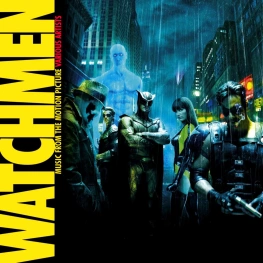
In 2019, Reznor and Ross composed the score for the independent drama Waves, and later that year made their second contribution to television with their score for Damon Lindelof's HBO miniseries Watchmen, a sequel to Alan Moore's original 1987 comic series. Reznor and Ross, both fans of the comic, approached Lindelof to work on the series, and released three volumes of music from the series over the course of its broadcast. The score was critically acclaimed, and Reznor and Ross won the Primetime Emmy Award for Outstanding Music Composition for a Limited Series in 2020.
In 2020, Reznor and Ross reunited with Fincher to score his drama film Mank as well as scoring their first animated project, Pixar's Soul. In 2021, the two won a Golden Globe and an Academy Award alongside Jon Batiste for their work on the Soul score.
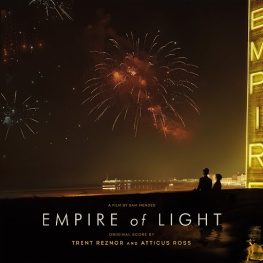
In 2022, Reznor and Ross scored Luca Guadagnino's Bones and All, as well as Sam Mendes's Empire of Light. In 2023, the duo scored their second animated project, Teenage Mutant Ninja Turtles: Mutant Mayhem, and reunited with Fincher for The Killer. In 2024, Reznor and Ross scored two films by Guadagnino: Challengers, and Queer. The two also composed the title theme for the HBO comedy series The Franchise; Mendes served as executive producer on the project, and directed the pilot.
In 2025, Reznor and Ross scored the sci-fi sequel Tron: Ares under the Nine Inch Nails moniker. The same year, the two also scored Scott Derrickson's The Gorge, as well as Guadagnino's After the Hunt.















.jpeg)


.jpeg)