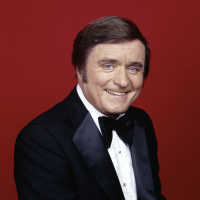
Michael Delaney Dowd Jr. (August 11, 1920 – August 11, 2006), known as Mike Douglas, was an American big band singer, entertainer, television talk show host of The Mike Douglas Show, and actor.
Dowd was born in Chicago, Illinois. His birth year has been called into question, with years ranging from 1920 to 1925 having been given as his year of birth at some point. His family later moved to Forest Park, Illinois, where he attended Proviso Township High School, but left the school after his second year. After that, he began singing as a choirboy.
Career
By his teens, Dowd was working as a singer at nightclubs and on a Lake Michigan dinner cruise ship. He was a "staff singer" at the Oklahoma City radio station WKY. After serving in the U.S. Navy in World War II on a munitions ship, he resumed his performing career as a staff singer for WMAQ-TV in Chicago. He moved to Los Angeles. He was on the Ginny Simms radio show. After that, Douglas joined the big band of Kay Kyser as a singer.
Although big band swing faded from popularity, Kyser had to continue performing due to contractual obligations, and continued to log a few hits with Douglas, including two notable hits, "Ole [or Old] Buttermilk Sky" in 1946 and "The Old Lamp-Lighter" the following year. Kyser was responsible for giving Douglas his show business name, and Douglas continued to perform with the band until Kyser retired in 1951 due to health problems. In 1950, he provided the singing voice of Prince Charming in Walt Disney's Cinderella.
In 1953, Douglas was host of Showcase, a weekly program on WGN-TV in Chicago, and he sang on The Music Show on the DuMont Television Network. In 1957 Douglas was one of the Band Singers on Dennis James' "Club 60" a daily talk show on NBC out of Chicago. Douglas and James remained lifelong friends, with James occasionally serving as a co-host on "The Mike Douglas Show" in Los Angeles in the 1970s.
Then living in Burbank, California, Douglas tried to keep his singing career going in the late 1950s working as house singer for a nightclub and traveling to perform elsewhere. By the middle of the decade, rock and roll and doo wop had taken over the charts, which left many older performers in the musical dustbin. In the leanest years, Douglas and his wife survived by successfully "flipping" their Los Angeles homes.